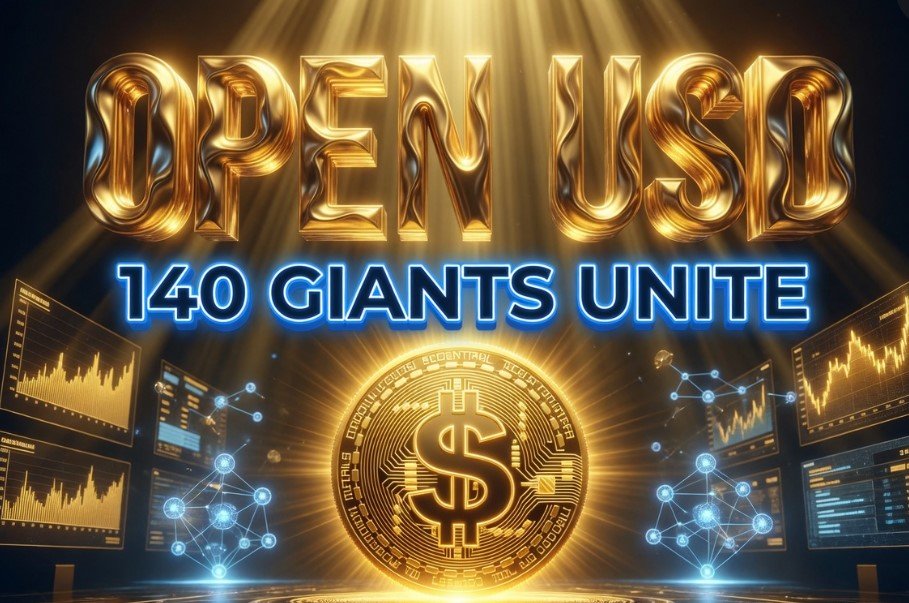
June 30, 2026 will be remembered as the day the stablecoin world got its first real shake-up. Mastercard, Visa, Stripe, BlackRock, and Coinbase joined over 140 companies to back Open USD (OUSD), a new stablecoin built for the internet economy. The announcement sent Circle’s stock crashing 17.55% in a single day and sparked one of the biggest debates the financial world has seen about the future of digital money.
What Is Open USD and Who Is Behind It
Open USD is a new US dollar-pegged stablecoin created by Open Standard, a brand-new independent company whose board is made up of its own partner organizations. The token carries the ticker OUSD and is expected to go live in the second half of 2026. It will launch natively on Solana from day one, then expand to Stellar, Base, Polygon and other major chains shortly after.
Zach Abrams, co-founder of Bridge, the stablecoin startup Stripe acquired for $1.1 billion, will serve as Open Standard’s founding CEO. He described the project simply: “It’s a stablecoin built for the internet economy, designed by the businesses growing it.”
Open Standard operates with a structure that looks far more like a payment network than a traditional crypto issuer. No single company controls it. Governance is shared across its board, which is drawn directly from its partner organizations.
The partner lineup is unlike anything the stablecoin industry has ever seen at a launch:
- Payment Networks: Visa, Mastercard, American Express, Discover, Adyen, Klarna
- Financial Institutions: BlackRock, BNY, Standard Chartered, U.S. Bank, BBVA, DBS
- Tech Platforms: Google, Shopify, Samsung Electronics, IBM, DoorDash
- Crypto Firms: Coinbase, Ripple, OKX, Bybit, MetaMask, Gemini, Aave
The Fee-Free Model That Sets OUSD Apart
The most disruptive thing about Open USD is not the technology. It is the economics.
Today, stablecoins like USDC and USDT generate enormous revenue for their issuers. The issuer parks customer dollars in US Treasuries and keeps all the interest earned. Businesses that distribute or use those stablecoins get absolutely nothing from those reserves.
OUSD completely reverses that model. Businesses can mint and redeem OUSD at zero cost, with no volume caps, and nearly all of the reserve earnings flow back to the partner companies after a small management fee is deducted.
| Feature | Open USD (OUSD) | USDC (Circle) | USDT (Tether) |
|---|---|---|---|
| Mint / Redeem Fees | Zero | Applies | Applies |
| Reserve Revenue | Shared with partners | Kept by issuer | Kept by issuer |
| Governance | Collective (140+ firms) | Single company | Single company |
| Launch Chain | Solana (day one) | Multi-chain | Multi-chain |
| Regulatory Posture | GENIUS Act compliant | GENIUS Act compliant | Offshore issuer |
Stripe’s President of Technology and Business, Will Gaybrick, put the commitment into words that left little room for interpretation. He said Open USD “will be the default stablecoin for businesses running on Stripe.” That is a massive statement from one of the world’s most powerful payment platforms.
The total stablecoin market is worth approximately $312 billion today. Tether’s USDT controls roughly 62% of that, while Circle’s USDC holds around 25%. BNY projects the overall market could reach $1.5 trillion by 2030.
Why Mastercard Is Going All In on Stablecoins
Joining Open USD is not Mastercard’s first significant move in the stablecoin space this year. Far from it.
In March 2026, Mastercard announced it was acquiring BVNK, a London-based stablecoin infrastructure firm, for up to $1.8 billion. It is the largest stablecoin acquisition any company in the world has ever made. The deal gives Mastercard the ability to connect its traditional payment rails directly with on-chain blockchain systems, enabling 24/7 stablecoin settlement across its global network.
Mastercard is not trying to compete with stablecoins. It is absorbing them into its existing global payment infrastructure. BVNK currently processes around $30 billion in annual transaction volume across all major blockchain networks in more than 130 countries.
Mastercard’s Chief Product Officer, Jorn Lambert, made the company’s direction clear when commenting on the OUSD launch. He said shared, interoperable infrastructure is the key to bringing stablecoins into the broader financial system. That same vision drove the BVNK acquisition earlier this year.
The broader pattern here is deliberate. Mastercard is positioning itself as the bridge between the traditional financial world and the on-chain economy. Whether a business wants to use OUSD, USDC, or any other regulated stablecoin in the future, Mastercard wants to be the network that moves it.
Market Reaction and What the Industry Is Saying
The market responded immediately and sharply.
Circle’s stock fell 17.55% on June 30, closing at $62.63, one of the company’s worst single-day sessions since its NYSE debut. The sell-off reflected something deeper than just competition. It was about who showed up to compete and how closely they were tied to Circle’s own business.
Some of OUSD’s founding partners, including BlackRock and BNY, are also deeply embedded in Circle’s ecosystem. Coinbase, which co-founded USDC’s original governance body, the Centre Consortium, joined the rival consortium while still holding a major revenue-sharing deal with Circle that is reportedly up for renewal in August.
Tether CEO Paolo Ardoino kept his response brief and confident. “Welcome OUSD. Player 2 has entered the game,” he wrote. Circle CEO Jeremy Allaire fired back with equal conviction:
“USDC remains the most trusted, widely adopted and institution-ready dollar stablecoin.”
Investment bank William Blair called the Circle sell-off an overreaction. It reaffirmed its Outperform rating on CRCL stock, pointing to USDC’s roughly $74 billion market value and deep existing liquidity as advantages that do not disappear overnight.
Not all analysts are convinced OUSD will win the fight, though. Dragonfly’s Rob Hadick acknowledged the partner list is a real threat but offered a sharp warning: coordinating 140 companies with competing commercial incentives is one of the hardest things to do in business. History supports that caution. Paxos launched a similar consortium-backed stablecoin called USDG in 2024 and it has stayed limited to about $3 billion in circulation. The execution challenge for Open USD is very real.
The regulatory backdrop also matters. The GENIUS Act, signed into US law in July 2025, established a federal framework for payment stablecoins and opened the door to exactly this kind of large-scale institutional push. Open Standard says OUSD’s reserves will be held at major financial institutions in full compliance with US regulatory requirements.
The stablecoin industry has never seen this level of institutional firepower lined up behind a single launch. Open USD brings together the distribution reach of Visa and Mastercard, the financial credibility of BlackRock and BNY, the technology scale of Google and Shopify, and the crypto infrastructure of Coinbase and Ripple. All under one roof. Whether that coalition can translate a historic announcement into real payment volume, sustained peg stability and genuine merchant adoption is the defining question of digital finance for the rest of 2026. What is already clear is that the era of Tether and Circle running the stablecoin world without a serious challenger is now over, and for businesses and everyday users who depend on fast, fair and affordable digital money, that is a very big deal.
What do you think? Can Open USD really take on Tether and Circle, or will this coalition face the same fate as past stablecoin alliances? Drop your opinion in the comments below.

Finn Wells is a proficient news writer at Crypto Quill, specializing in delivering the latest updates on Bitcoin and altcoins to readers worldwide. With a keen interest in the ever-changing landscape of digital currencies, Finn’s articles provide insightful analysis and up-to-the-minute news on the cryptocurrency market. Known for his meticulous research and commitment to accuracy, Finn brings a fresh perspective to the world of blockchain technology. Stay informed with Finn’s comprehensive coverage of Bitcoin and altcoins, as he continues to illuminate the crypto space with his expertise and dedication at Crypto Quill.
 Bitcoin
  Ethereum
  Tether
  BNB
BNB  USDC
USDC  XRP
XRP  Solana
  TRON
TRON  Figure Heloc
  Lido Staked Ether
  Hyperliquid
  Dogecoin
  USDS
USDS  Rain
Rain  LEO Token
  Wrapped stETH
  Zcash
Zcash  Monero
  Wrapped Bitcoin
  Cardano
  Binance Bridged USDT (BNB Smart Chain)
  Chainlink
  Wrapped Beacon ETH
  WhiteBIT Coin
  Stellar
  Dai
Dai  Wrapped eETH
  Bitcoin Cash
  USD1
USD1  sUSDS
sUSDS  Canton
  Ethena USDe
  Gram (prev. Toncoin)
  Coinbase Wrapped BTC
  Litecoin
  Global Dollar
  Circle USYC
  WETH
WETH  Hedera
  Sui
Sui  PayPal USD
  USDT0
USDT0  BlackRock USD Institutional Digital Liquidity Fund
  Avalanche
  Tether Gold
  Shiba Inu
  Uniswap
  Cronos
  NEAR Protocol
  Ethena Staked USDe
  Ondo US Dollar Yield
  OKB
OKB  Bittensor
  PAX Gold
  World Liberty Financial
  HTX DAO
  Ondo
Ondo  Aster
Aster  Ripple USD
  USDD
USDD  Little Pepe
  MemeCore
  syrupUSDC
  Wrapped BOT
  Mantle
  Aave
Aave  Polkadot
  Falcon USD
  BFUSD
BFUSD  Morpho
  Sky
Sky  Internet Computer
  United Stables
  Worldcoin
  Pepe
Pepe  USDGO
USDGO  Bitget Token
  Spiko Amundi Overnight Swap Fund (EUR)
  Pump.fun
  Jupiter Perpetuals Liquidity Provider Token
  Ethereum Classic
  Pi Network
  Blockchain Capital
  Invesco Short Duration US Government Securities Fund
  Spiko EU T-Bills Money Market Fund
  Jito Staked SOL
  KuCoin
  Ethena
  Kelp DAO Restaked ETH
  Janus Henderson Anemoy Treasury Fund
  Quant
Quant  Binance-Peg WETH
  JUST
JUST  Rocket Pool ETH
  Stable
  POL (ex-MATIC)
  Binance Bridged USDC (BNB Smart Chain)
  Cosmos Hub
  Algorand
  Wrapped BNB